 Duskverin
Purpose
Duskverin organises information into a structured, navigable form so that users can review and examine content systematically.
Interface
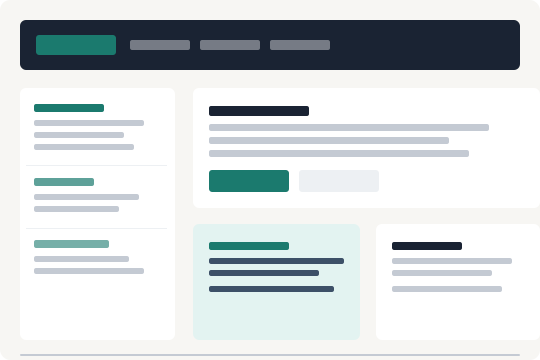
The system presents content through a layered interface that reflects the underlying classification applied to each item.
Access
Access to the full system is available on request. Users can submit an enquiry to begin the process.
What Duskverin is intended to do
Duskverin is an information-organisation system built to address a specific challenge: information is often available in quantity but difficult to navigate without a consistent structure applied to it. The platform provides that structure.
When content is introduced to the system, it passes through a classification layer that assigns categories, marks relationships, and prepares the material for presentation through the interface. By the time a user encounters a piece of information, the organising work has already been done.
This means users arrive at a reviewed, classified view of content rather than an unstructured stream. The platform does not generate conclusions; it arranges what is present and makes it possible to inspect each item in relation to others.
Navigating the system layer by layer
The interface is structured around the same categories used to organise the content. Moving through the system means moving through its classification rather than searching across an undifferentiated list.
-
Category-level entry
Users begin at the category level. Duskverin presents the top-level classification structure so that the overall shape of the available content is visible before any individual item is selected. This provides orientation before inspection.
-
Filtered navigation within categories
Within each category, the system applies further sub-classifications. Users can move through these layers to narrow the content they are reviewing without needing to formulate a search query.
-
Individual item review
When a specific item is selected, the system presents it alongside its classification context: which category it belongs to, what related items share the same grouping, and what additional information is attached. The item is never shown in isolation from its organisation.
-
Cross-reference and return paths
The interface includes reference links that allow users to move between related categories or return to a higher classification level. This makes it possible to follow the organisation of the content rather than relying solely on a browsing history.
What users should understand before requesting access
Duskverin organises information that has been introduced to the system. It does not retrieve or generate information independently of what it has been given to classify. This is an important distinction: the system provides structure, not source material.
The classification layer applies consistent rules across all content, but it cannot guarantee that every item has been classified with the same precision. Where classification confidence is lower, the system notes this rather than presenting an uncertain assignment as definitive.
Users should review the available content critically. The fact that information has been organised by the system does not constitute an endorsement of that content or an assessment of its accuracy. The platform presents what is present in an organised form; verifying the underlying material remains the responsibility of the user.
Access to the system is not automatic. The team reviews each access request and may ask clarifying questions before confirming access. This process exists to ensure that users understand the scope and limitations of the system before they begin working with it.
Frequently asked about the platform
-
Does Duskverin create or generate the information it presents?
No. Duskverin organises information that has been provided to the system. The platform applies classification logic to existing content; it does not produce new information independently. If you are looking for content that is not already within the system, Duskverin cannot create it.
-
How is the classification applied to content?
The system uses a rule-based classification layer that assigns categories according to the properties of each piece of content. The rules are applied consistently across all items. Users can view the classification assigned to any item and understand why it has been grouped as it has.
-
Is the organised content kept up to date?
The platform reflects the content that has been introduced to it. Updates to the underlying content are processed by the classification layer when they occur. The recency of any given item depends on when that content was last submitted to the system.
-
What happens if the system classifies something incorrectly?
The classification layer is designed to handle ambiguity by flagging items where confidence is lower rather than assigning a definitive category without justification. Users who identify a classification that appears incorrect can report this through the enquiry form, and the support team will review it.
-
Can users customise how the interface is organised?
The core classification structure of Duskverin reflects the categories applied during content processing. Individual users can navigate the system in the order that suits their purpose, but the underlying organisation is a property of the content rather than a configurable view layer.
Interested in working with Duskverin?
If you have reviewed this overview and want to proceed, the enquiry form is the next step. The team will confirm access and answer any outstanding questions.
Send an enquiry